14803 This document is effective from 1 January 2027 to accompany PS1/26.
14804Please see: www.bankofengland.co.uk/prudential-regulation/publication/2026/january/implementation-of-basel-3-1-final-rules-policy-statement.
14805 PRA2026/1
14807 𝑆𝑆 𝑗 (𝑇)= the expected shortfall measure that is determined with a 10-day time horizon for
14808 only the non-modellable risk factors in standardised bucket j
14809 For the extreme scenarios of future shock, an institution shall comply with the requirements in
14810 paragraph 3.
14811 Calculation and use of time series of returns for developing extreme scenarios of future shock
14812 8. Where an institution elects to determine the extreme scenarios of future shock based on a time
14813 series of returns on the non-modellable risk factor or returns on other risk factors, the institution
14814 shall use a time series of 10 business days returns that are determined as follows:
14815 (a) they shall determine the time series of observations for the non-modellable risk factor for
14816 the relevant period;
14818 (b) by way of derogation from the first paragraph, they may extend the time series referred to
14819 in point (a) by including the observations available within the period of 20 business days
14820 following the stress period; where the reference date for the calculation of the stress
14821 scenario risk measure is less than 20 business days after the end of the stress period, an
14822 institution may include those observations that are available from the end of the stress
14823 period to the reference date;
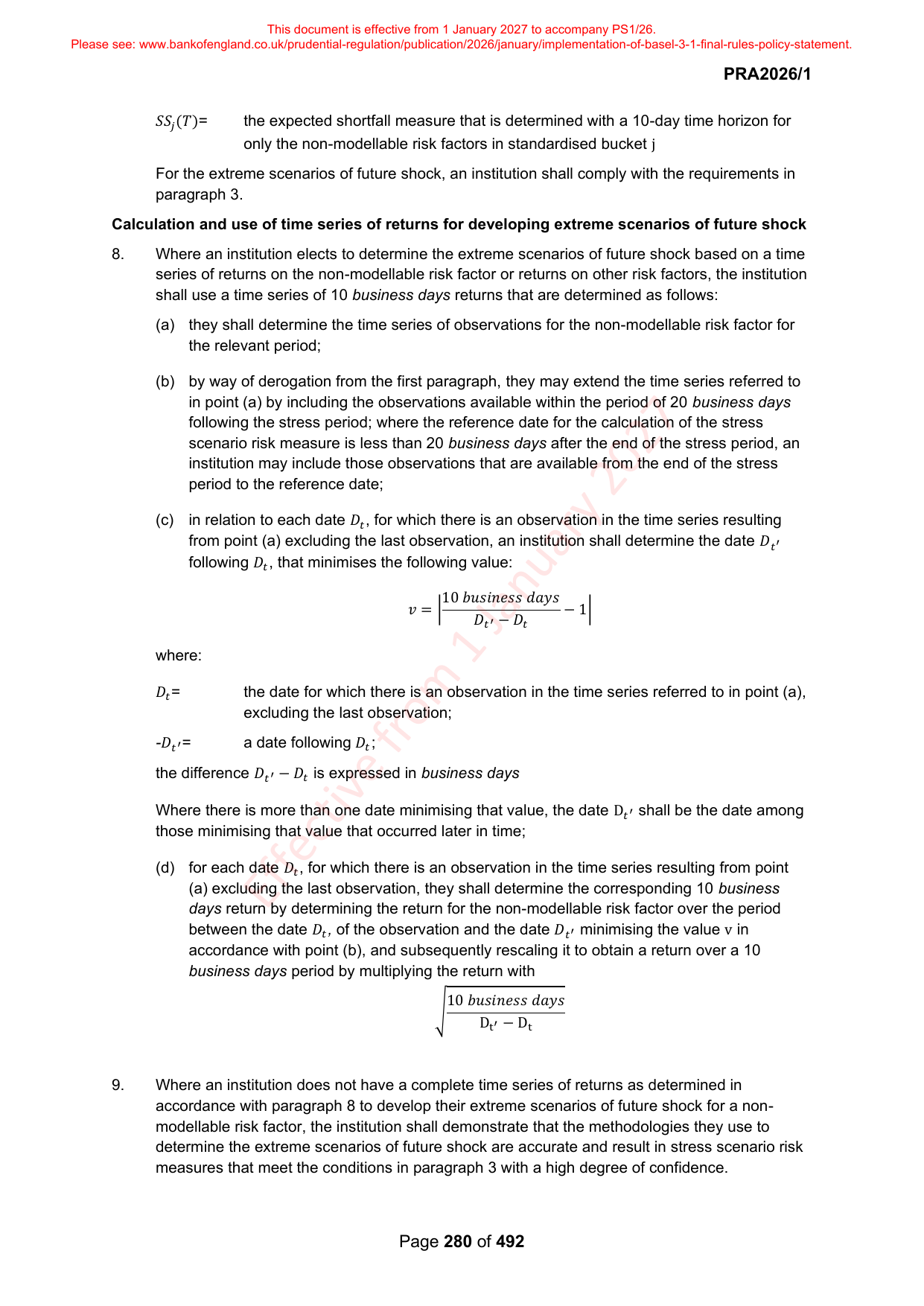
14825 (c) in relation to each date 𝐷 𝑡 , for which there is an observation in the time series resulting
14826 from point (a) excluding the last observation, an institution shall determine the date 𝐷 𝑡 ′
14827 following 𝐷 𝑡 , that minimises the following value:
14829 10 𝑏𝑢𝑠𝑖𝑛𝑒𝑠𝑠 𝑑𝑎𝑦𝑠
14830 𝑣=| − 1|
14831 𝐷 𝑡 ′ − 𝐷 𝑡
14833 where:
14835 𝐷 𝑡 = the date for which there is an observation in the time series referred to in point (a),
14836 excluding the last observation;
14837 -𝐷 𝑡 ′ = a date following 𝐷 𝑡 ;
14838 the difference 𝐷 𝑡 ′ − 𝐷 𝑡 is expressed in business days
14840 Where there is more than one date minimising that value, the date D 𝑡 ′ shall be the date among
14841 those minimising that value that occurred later in time;
14843 (d) for each date 𝐷 𝑡 , for which there is an observation in the time series resulting from point
14844 (a) excluding the last observation, they shall determine the corresponding 10 business
14845 days return by determining the return for the non-modellable risk factor over the period
14846 between the date 𝐷 𝑡 , of the observation and the date 𝐷 𝑡 ′ minimising the value v in
14847 accordance with point (b), and subsequently rescaling it to obtain a return over a 10
14848 business days period by multiplying the return with
14849 10 𝑏𝑢𝑠𝑖𝑛𝑒𝑠𝑠 𝑑𝑎𝑦𝑠
14850 √
14851 D t ′ − D t
14853 9. Where an institution does not have a complete time series of returns as determined in
14854 accordance with paragraph 8 to develop their extreme scenarios of future shock for a non-
14855 modellable risk factor, the institution shall demonstrate that the methodologies they use to
14856 determine the extreme scenarios of future shock are accurate and result in stress scenario risk
14857 measures that meet the conditions in paragraph 3 with a high degree of confidence.
14859 Page 280 of 492