14686 This document is effective from 1 January 2027 to accompany PS1/26.
14687Please see: www.bankofengland.co.uk/prudential-regulation/publication/2026/january/implementation-of-basel-3-1-final-rules-policy-statement.
14688 PRA2026/1
14690 (c) the use of hypothetical portfolios to ensure that the risk measurement model is able to
14691 account for particular structural features that may arise, for example, material basis risks
14692 and concentration risk, or the risks associated with the use of proxies.
14694 [Note: This rule corresponds to Article 325bj of CRR as it applied immediately before revocation by
14695 the Treasury]
14697 Article 325bk CALCULATION OF STRESS SCENARIO RISK MEASURE
14699 1. For the purposes of this Article, the ‘stress scenario risk measure’ of a given non-modellable
14700 risk factor means the loss that is incurred in all trading book positions or non-trading book
14701 positions that are subject to foreign exchange or commodity risk of the portfolio which includes
14702 that non-modellable risk factor when an extreme scenario of future shock is applied to that risk
14703 factor.
14704 2. An institution shall develop appropriate extreme scenarios of future shock for all non-
14705 modellable risk factors.
14706 Development of extreme scenarios of future shock for individual risk factors
14707 3. An institution shall develop the extreme scenarios of future shock for a single non-modellable
14708 risk factor for the purposes of paragraph 2 such that the resulting stress scenario risk measure
14709 is at least as conservative as:
14710 (a) an expected shortfall measure calculated for that non-modellable risk factor alone;
14712 (b) for the stress period in accordance with paragraph 10;
14714 (c) at 97.5 th percentile, one tailed confidence interval;
14716 (d) calculated with base time horizon of 10 days; and
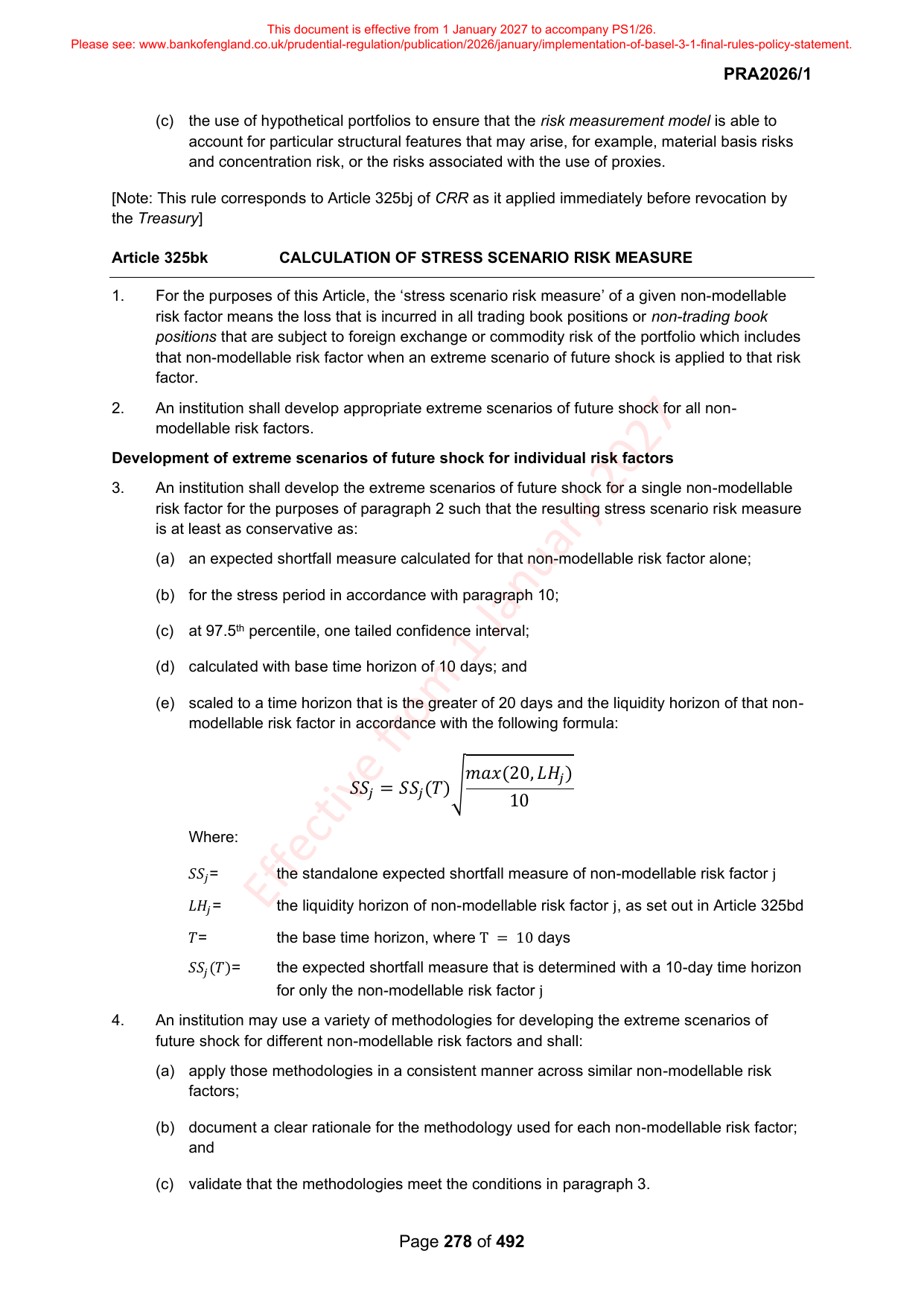
14718 (e) scaled to a time horizon that is the greater of 20 days and the liquidity horizon of that non-
14719 modellable risk factor in accordance with the following formula:
14721 𝑚𝑎𝑥(20, 𝐿𝐻 𝑗 )
14722 𝑆𝑆 𝑗 = 𝑆𝑆 𝑗 (𝑇)√
14723 10
14725 Where:
14727 𝑆𝑆 𝑗 = the standalone expected shortfall measure of non-modellable risk factor j
14729 𝐿𝐻 𝑗 = the liquidity horizon of non-modellable risk factor j, as set out in Article 325bd
14731 𝑇= the base time horizon, where T = 10 days
14733 𝑆𝑆 𝑗 (𝑇)= the expected shortfall measure that is determined with a 10-day time horizon
14734 for only the non-modellable risk factor j
14735 4. An institution may use a variety of methodologies for developing the extreme scenarios of
14736 future shock for different non-modellable risk factors and shall:
14737 (a) apply those methodologies in a consistent manner across similar non-modellable risk
14738 factors;
14740 (b) document a clear rationale for the methodology used for each non-modellable risk factor;
14741 and
14743 (c) validate that the methodologies meet the conditions in paragraph 3.
14745 Page 278 of 492