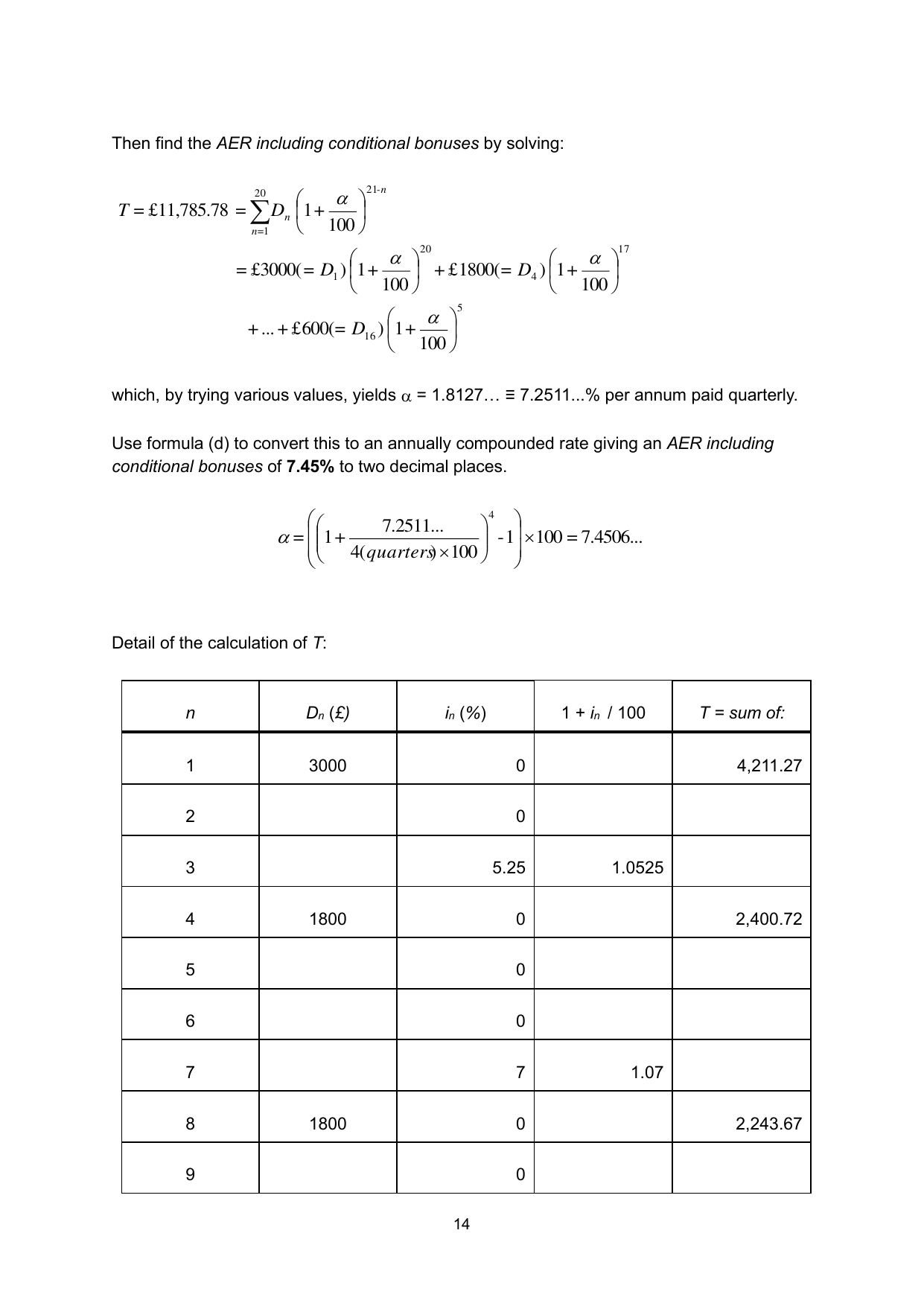
711Then find the AER including conditional bonuses by solving:
714
715 21- n
716 20
717
718T = £11,785.78 = Dn 1+
719 n=1 100
720
721 20 17
722
723 = £3000( = D1 ) 1+ + £1800(= D4 ) 1+
724 100 100
725
726 5
727
728 + ... + £600(= D16 ) 1+
729 100
731which, by trying various values, yields = 1.8127… ≡ 7.2511...% per annum paid quarterly.
733Use formula (d) to convert this to an annually compounded rate giving an AER including
734conditional bonuses of 7.45% to two decimal places.
737 7.2511...
738 4
739
740 = 1 + - 1 100 = 7.4506...
741 4( quarters) 100
742
746Detail of the calculation of T:
750 n Dn (£) in (%) 1 + in / 100 T = sum of:
753 1 3000 0 4,211.27
755 2 0
757 3 5.25 1.0525
759 4 1800 0 2,400.72
761 5 0
763 6 0
765 7 7 1.07
767 8 1800 0 2,243.67
769 9 0
771 14