653branch leaflet, it would be displayed only during November 1999 (see Section 6 above on
654‘Bonuses’).
6588. Finally, consider a hypothetical product with irregular (but committed) cash flows.
660The pattern of this product is:
662 • Deposit £3,000 on 1 April in year 1, then
663 • £1,800 on 1 January each year for three years, and then
664 • £600 on 1 January in year 5,
665 • a total of £9,000 to be repaid on 1 April in year 6.
668Interest at 7% per annum is added to the account on 31 December each year and at
669repayment, together with a 2% bonus of the total amount deposited (£9,000) for making the
670required deposits and holding to maturity.
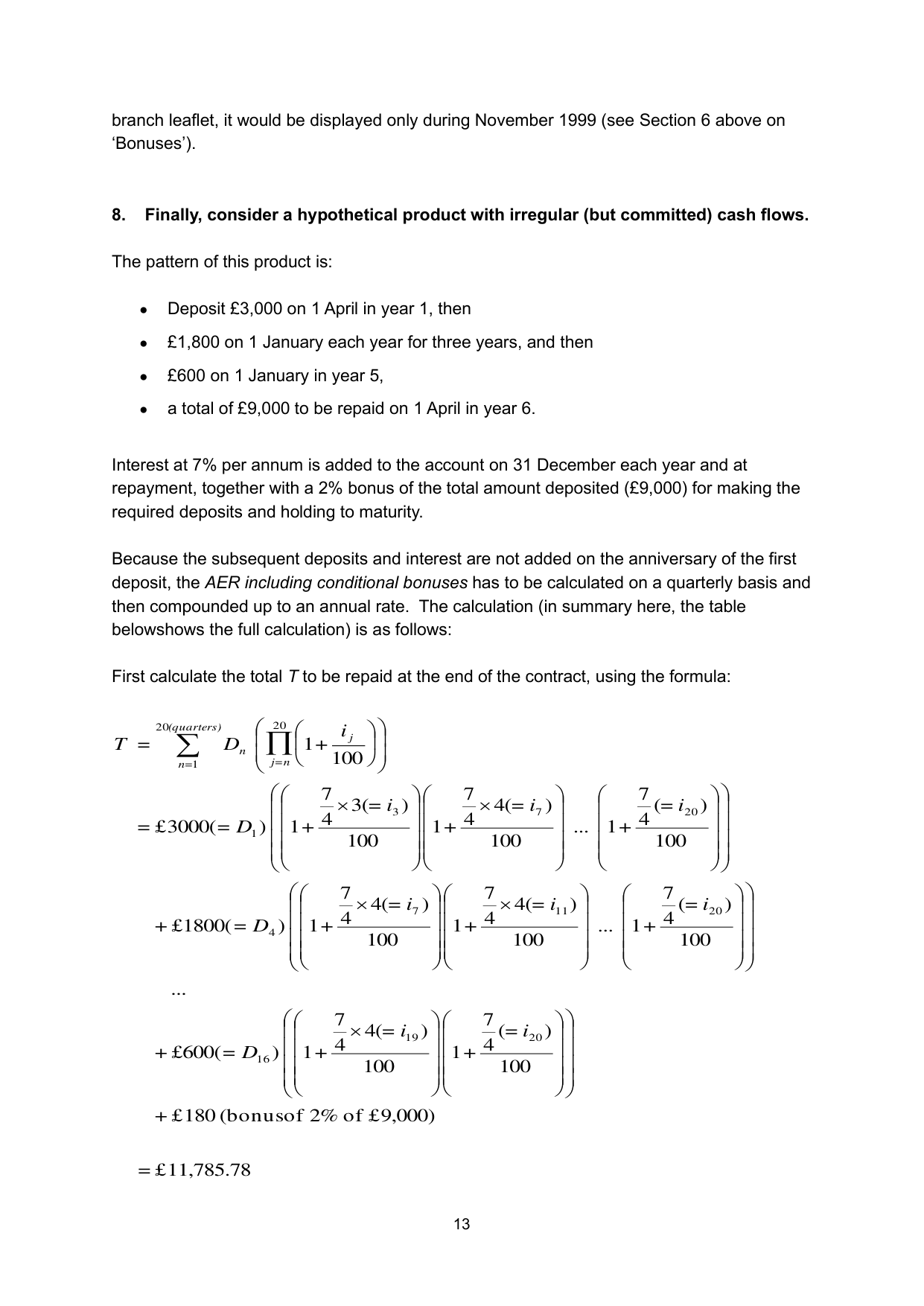
672Because the subsequent deposits and interest are not added on the anniversary of the first
673deposit, the AER including conditional bonuses has to be calculated on a quarterly basis and
674then compounded up to an annual rate. The calculation (in summary here, the table
675belowshows the full calculation) is as follows:
677First calculate the total T to be repaid at the end of the contract, using the formula:
680 20
681 20(quarters)
682 i
683T = D 1+ j
684 n
685 j=n 100
686 n=1
687 7 7 7
688 3(= i3 ) 4(= i7 ) (= i20 )
689 = £3000(= D1 ) 1 + 4 1 + 4 ... 1 + 4
690 100 100 100
691
692
693 7 7 7
694 4(= i7 ) 4(= i11 ) (= i20 )
695 + £1800( = D4 ) 1 + 4 1 + 4 ... 1 + 4
696 100 100 100
697
698
699 ...
700 7 7
701 4(= i19 ) (= i20 )
702 + £600(= D16 ) 1 + 4 1 + 4
703 100 100
704
705
706 + £180 (bonusof 2% of £9,000)
708 = £11,785.78
710 13